
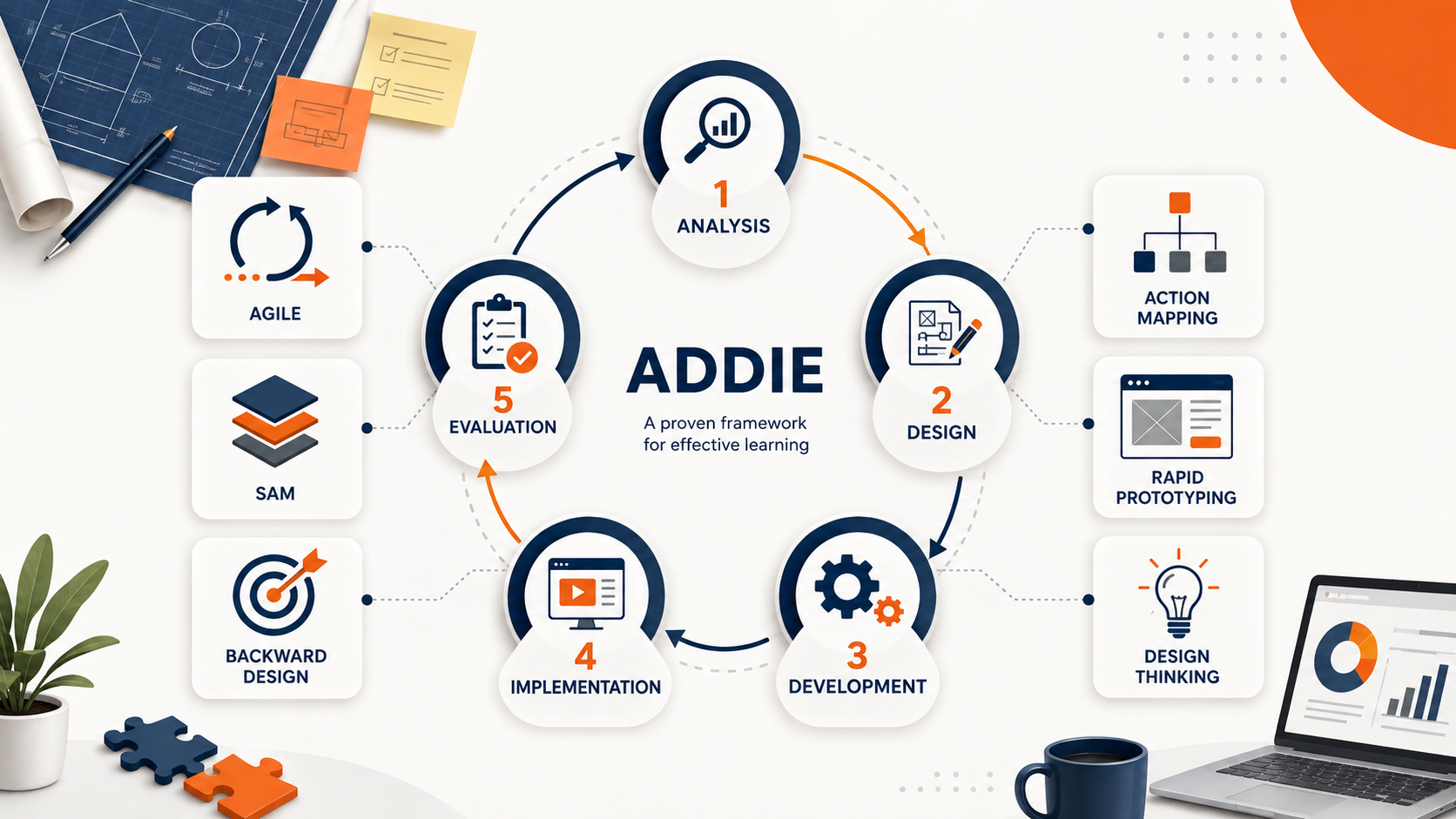
ADDIE is one of the most widely recognised models in instructional design. It is also one of the most misunderstood.
Some course developers treat ADDIE in course design as a strict sequence of steps that must be completed before the next can begin. Others dismiss it as outdated, slow or overly bureaucratic. Both views miss the point.
ADDIE is best understood as a framework for making sure important questions are answered during course design and development. It provides structure, but it does not prescribe a particular project plan, authoring tool or development speed.
Used well, ADDIE in course design can support everything from a short online module to a complex blended training program. It can also be combined with approaches such as rapid prototyping, backward design, action mapping, Agile development and the Successive Approximation Model.
The real question is not whether ADDIE is still relevant. It is how to apply it intelligently.
What is ADDIE in course design?
ADDIE represents five broad phases:
- Analysis
- Design
- Development
- Implementation
- Evaluation
The model provides a logical pathway from identifying a learning need to delivering and reviewing the finished course.
Although the phases are often presented in a straight line, effective course development is rarely that tidy. New information emerges. Subject matter experts change their minds. Technical constraints appear. Draft activities reveal gaps in the original design.
A well-managed ADDIE project allows movement between phases. Evaluation occurs throughout the process—not only after the course has been delivered.
Analysis: Understanding the Actual Problem
The analysis phase establishes why the course is needed and what it is expected to achieve.
This should involve more than accepting a request such as:
“We need an online course on communication.”
That request describes a possible solution, not necessarily the problem.
A proper analysis considers:
- the performance or capability gap;
- the people who will complete the training;
- what they already know;
- the tasks they must perform;
- the conditions under which they perform them;
- relevant workplace, regulatory or organisational requirements;
- the consequences of poor performance;
- available technology, time and resources; and
- whether training is actually the right response.
Not every performance problem is caused by a lack of knowledge or skill. Employees may already know what to do but lack the equipment, authority, information, time or management support to do it.
No amount of eLearning will repair a broken process.
For registered training organisations, analysis may also include reviewing the training product, assessment requirements, learner cohort, delivery context, industry expectations and compliance obligations.
This phase prevents the development team from building an attractive course that solves the wrong problem.
Design: Planning the Learning Experience
The design phase converts the findings from analysis into a structured learning solution.
This includes determining:
- learning outcomes;
- content sequence;
- delivery methods;
- practice activities;
- assessment methods;
- feedback;
- learner support;
- accessibility requirements;
- media and interaction choices; and
- how course effectiveness will be measured.
Good design begins with what learners must be able to do after the course—not with what information can be placed on slides.
A course about workplace risk management, for example, should not merely define hazards, controls and risk ratings. Learners should practise identifying hazards, evaluating risks, selecting controls, documenting decisions and responding to changing conditions.
The design phase should establish how that practice will occur before development begins.
Depending on the project, design documentation may include a course outline, learning map, storyboard, assessment plan, prototype or detailed design document.
The appropriate level of documentation depends on the size, risk and complexity of the project. A ten-minute internal module does not require the same design process as a nationally recognised qualification or safety-critical aviation course.
Development: Building and Testing the Course
Development is where the design becomes a usable learning product.
This may involve:
- writing content and narration;
- building eLearning modules;
- creating facilitator and participant resources;
- producing videos, graphics or animations;
- developing scenarios and simulations;
- configuring an LMS;
- creating assessment tools; and
- conducting quality assurance and technical testing.
Development should not be confused with simply transferring information into an authoring tool.
Software such as Articulate Storyline, Rise, Adobe Captivate or an LMS can help produce and distribute learning. It cannot determine whether the learning experience is relevant, accurate or effective.
Regular review is essential during development. Waiting until the entire course is complete before showing it to stakeholders creates unnecessary risk. By that point, even small changes may require significant rework.
Prototypes, sample screens and early draft activities allow stakeholders to test the direction of the course before too much time is invested.
Implementation: Putting the Course Into Practice
Implementation involves more than uploading a SCORM package and sending learners a link.
It includes preparing the environment in which the training will operate.
Depending on the course, this may involve:
- configuring enrolments and completion rules;
- briefing facilitators and assessors;
- testing learner access;
- confirming browser and device compatibility;
- preparing communications and support materials;
- establishing escalation processes;
- scheduling face-to-face or virtual sessions;
- managing pilot groups; and
- monitoring the initial rollout.
A course can be well designed and still fail because learners cannot log in, facilitators do not understand the intended delivery approach or managers do not provide time for completion.
Implementation connects the learning product with the workplace in which it is expected to function.
Evaluation: Determining Whether It Worked
Evaluation should occur throughout the project.
During design and development, formative evaluation helps identify problems before release. This may include expert review, prototype testing, pilot delivery, proofreading, accessibility checks and assessment validation.
After implementation, summative evaluation considers the effectiveness of the completed course.
Questions may include:
- Did learners complete the training?
- Could they demonstrate the required knowledge and skills?
- Did their workplace performance improve?
- Were the intended business or operational outcomes achieved?
- What problems did learners, facilitators or administrators encounter?
- Does the course need to be revised?
Completion rates and learner satisfaction are useful indicators, but they do not prove that learning occurred.
A course can receive excellent feedback because it was brief, entertaining and easy to complete while making no meaningful difference to workplace performance.
Evaluation should be linked to the purpose identified during analysis.
Is ADDIE in Course Design Too Slow?
ADDIE in course design is often criticised as a waterfall model in which every decision must be finalised before development begins.
That approach can certainly be slow. It can also be avoided.
Nothing within ADDIE prevents a team from:
- building prototypes early;
- working in short development cycles;
- reviewing sections as they are completed;
- testing ideas with learners;
- revising the design as new information emerges; or
- delivering the course in stages.
The problem is not usually ADDIE within course design itself. The problem is treating the model as a rigid approval process rather than a flexible design framework.
A small project may move through analysis and design in a matter of hours. A complex project may require extensive consultation, assessment design, validation and testing.
The amount of work should reflect the risk and complexity of the course.
The Successive Approximation Model
The Successive Approximation Model, commonly known as SAM, was developed as a more explicitly iterative alternative to traditional linear development.
SAM uses repeated cycles of design, prototyping, review and refinement.
Instead of attempting to define every detail before development begins, the team creates something tangible early, tests it and improves it through successive versions.
This can be particularly useful when:
- stakeholders struggle to respond to written design documents;
- the course includes complex interactions or scenarios;
- requirements are likely to change;
- visual treatment is important; or
- a project needs to demonstrate progress quickly.
SAM does not remove the need for analysis or planning. It changes how those activities are organised.
Poorly managed iteration can create its own problems. Endless feedback cycles, uncontrolled changes and unclear decision-making can consume more time than a structured process.
Iteration works best when review points, responsibilities and approval boundaries are clearly defined.
Agile Learning Development
Agile approaches divide a project into smaller pieces of work that can be designed, developed, reviewed and delivered progressively.
A large course might be divided into modules, topics, scenarios or capabilities. The team works on the highest-priority components first and adjusts later work based on feedback.
Agile development can be valuable where:
- content is changing;
- early delivery is important;
- several stakeholders must collaborate;
- priorities may shift; or
- the complete solution cannot be defined at the beginning.
However, Agile does not mean developing without a plan.
The overall learning outcomes, audience, constraints and quality expectations still need to be understood. Otherwise, the project may produce a series of polished components that do not form a coherent course.
For accredited training, Agile development must also accommodate requirements such as assessment mapping, validation, version control and consistency across the broader training and assessment strategy.
Backward Design
Backward design begins by defining the desired result.
The designer first asks:
What must learners be able to do?
The next question is:
What evidence would demonstrate that they can do it?
Only then does the designer determine what content, activities and support learners will need.
This approach is particularly useful for competency-based training because it creates a clear connection between outcomes, assessment and learning activities.
It also reduces the tendency to include content simply because it is available or interesting.
When backward design is applied properly, every major part of the course has a reason to be there.
Action Mapping
Action mapping, developed by Cathy Moore, places workplace behaviour at the centre of course design.
The process begins with a measurable organisational goal and identifies the actions people must take to achieve it. Designers then determine why those actions are not occurring and which barriers can be addressed through practice.
Content is added only where it supports the required action.
Action mapping is especially useful when stakeholders request information-heavy training. It shifts the discussion from:
“What does the course need to cover?”
to:
“What must people do differently?”
The resulting learning is often more scenario-based, practical and concise.
It also helps identify non-training solutions, such as job aids, clearer procedures, system changes or improved supervision.
Rapid Prototyping
Rapid prototyping involves creating an early working version of part of the course.
The prototype might demonstrate:
- navigation;
- visual style;
- a scenario;
- an interaction;
- a video treatment;
- an assessment activity; or
- the proposed learner experience.
Stakeholders can then respond to something concrete rather than trying to imagine the finished product from a document.
Rapid prototyping works particularly well alongside ADDIE. A prototype developed during the design phase can test assumptions before full production begins.
The purpose is not to make the course quickly at any cost. It is to identify problems while they are still relatively easy to fix.
Design Thinking
Design thinking applies a human-centred approach to problem-solving.
It usually involves understanding users, defining their needs, generating possible solutions, prototyping and testing.
In course design, this can mean observing how employees perform tasks, interviewing learners, exploring their frustrations and testing learning activities with representative users.
Design thinking is valuable because training decisions are often made by managers, technical specialists and compliance personnel who experience the workplace differently from learners.
It encourages the development team to examine the course from the learner’s perspective without losing sight of operational or regulatory requirements.
Which Methodology Should You Use?
These approaches do not need to compete.
A project might use:
- ADDIE in course design as the overall framework;
- action mapping to identify the required workplace behaviours;
- backward design to align outcomes, assessment and learning activities;
- design thinking to understand learner needs;
- rapid prototyping to test the proposed experience;
- Agile practices to manage development; and
- SAM-style iteration to refine the course through repeated review.
The most appropriate combination depends on the project.
A compliance module addressing a straightforward policy update may require a light analysis, a simple design and rapid development.
A qualification involving practical assessment, workplace evidence and safety-critical tasks requires a much more rigorous process.
The methodology should support the work—not become the work.
A Practical Approach
For many projects, the following approach provides an effective balance:
Start with the performance requirement
Clarify what learners must know or do and why it matters.
Identify acceptable evidence
Determine how competence, capability or changed performance will be demonstrated.
Analyse the audience and environment
Understand the learners, workplace, technology, constraints and risks.
Design the experience
Plan the sequence, practice, feedback, support and assessment before building screens.
Prototype early
Develop a representative section and test it with stakeholders and learners.
Build in manageable stages
Review and approve components progressively rather than waiting until the end.
Test the complete experience
Check content, functionality, accessibility, reporting, navigation and assessment behaviour.
Evaluate and improve
Use learner feedback, assessment results, facilitator observations and workplace evidence to guide revisions.
ADDIE Is a Framework, Not a Religion
No instructional design model can guarantee a good course.
A project can follow ADDIE perfectly and still produce dull, irrelevant training. Another project can use a highly iterative approach and descend into endless revision without clear outcomes.
Effective course development requires sound judgement.
The designer must understand the problem, focus on what learners need to do, provide meaningful practice, collaborate effectively with subject matter experts and test whether the solution works.
ADDIE in course design remains useful because those fundamentals have not changed.
The best course design methodology is not necessarily the newest, fastest or most fashionable. It is the one that helps the development team make informed decisions, manage risk and create learning that produces the required result.
Need help designing learning that is practical, engaging and built around real performance outcomes? PeppercornMedia develops custom eLearning, course materials and LMS-ready training solutions for RTOs, businesses and industry organisations. Check out our services to learn more.