
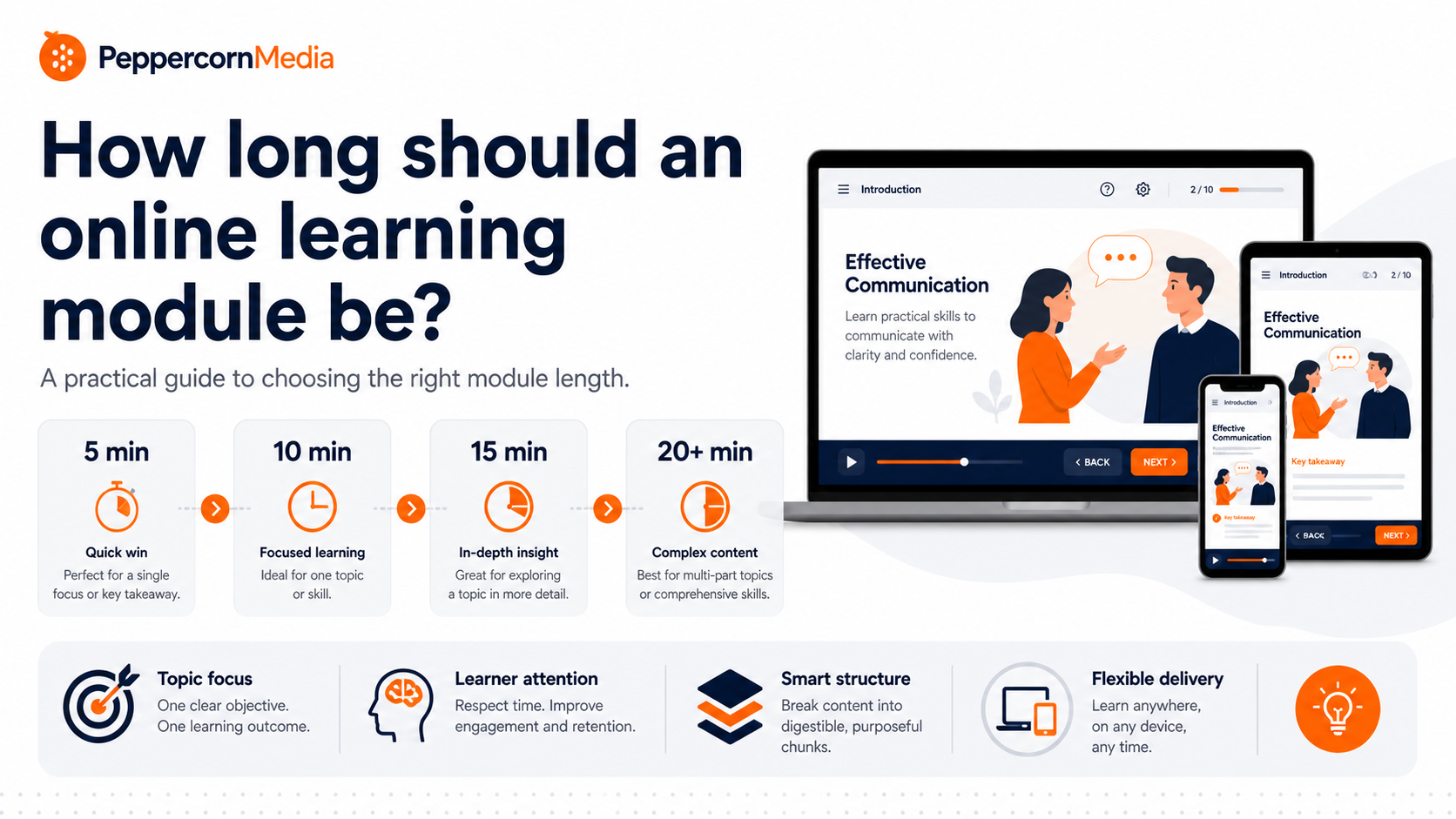
One of the most common questions in eLearning development is:
How long should the module be?
The honest answer is: long enough to do the job, but short enough that learners can stay focused.
That may sound vague, but it is often the most practical answer. A useful module is not measured only by minutes. It is measured by whether the learner can understand the content, apply it and complete the training without unnecessary friction.
Still, length matters. A module that is too long can become tiring. A module that is too short may skip the context learners need. The aim is to find the right fit for the topic, audience and delivery purpose.
Shorter is usually better
In most cases, shorter online modules work better than long ones.
That does not mean cutting important content. It means being disciplined about what belongs in the module.
Learners are often completing online training around their normal work. They may be fitting it between tasks, during quiet periods or as part of a compliance requirement. If the module feels too long or too dense, attention drops quickly.
A short, focused module gives learners a clearer path.
It also makes the course easier to update, easier to test and easier to fit into an LMS structure.
A useful rule of thumb
For many workplace topics, a good target is around 5 to 15 minutes.
That range works well for:
- short inductions
- policy updates
- refresher training
- compliance awareness
- simple process explanations
- quick knowledge checks
- focused skill refreshers
A 10-minute module is often enough to introduce one clear topic, explain the key points, show an example and include a short knowledge check.
However, that does not mean every topic should be forced into 10 minutes. Some topics need more time. Others need less.
One module, one clear purpose
A common problem is trying to make one module do too much.
For example, a course might try to cover:
- background information
- legal obligations
- workplace procedures
- multiple roles and responsibilities
- several scenarios
- a final assessment
- technical system instructions
That may be too much for one module.
Instead, it may be better to split the content into a short course made up of several smaller modules. Each module can then focus on one clear purpose.
For example:
- Module 1: Why the topic matters
- Module 2: Key responsibilities
- Module 3: Applying the process
- Module 4: Scenarios and knowledge check
This makes the learning easier to complete and easier to revisit later.
Length depends on the task
The right length depends on what the learner needs to do.
If the learner only needs awareness, the module can usually be short.
For example:
Learners need to understand the key changes in a policy.
That may only need 5 to 10 minutes.
However, if the learner needs to make decisions, practise a process or understand consequences, the module may need more time.
For example:
Learners need to choose the correct response in realistic workplace scenarios.
That may require 15 to 30 minutes, especially if the module includes practice questions and feedback.
The more the learner needs to apply the content, the more carefully the module needs to be designed.
Content volume is not the same as learning time
A large amount of source content does not automatically mean a long module.
A 40-page document does not need to become a 40-minute eLearning course.
In fact, turning a document into online learning often means reducing, reorganising and reshaping the content. The learner does not need to read everything the organisation knows about a topic. They need the right information at the right time.
This is where content review matters.
Some information may belong in the module. Other information may belong in a downloadable reference. And some may be better handled through workplace procedures, supervisor guidance or follow-up resources.
The module should not become a dumping ground for every available document.
Avoid “content creep”
Content creep happens when more and more information gets added to the module during development.
It often starts with comments like:
- “Can we just add this policy section?”
- “We should probably include the full procedure.”
- “Let’s add this extra background information.”
- “Legal wants this paragraph included.”
- “The manager asked for another scenario.”
Sometimes those additions are necessary. However, each extra piece of content adds time, complexity and cognitive load.
Before adding more content, ask:
Does the learner need this to complete the learning outcome?
If the answer is no, the content may belong somewhere else.
Use resources instead of overloading the module
Not all information needs to sit inside the main learning flow.
Supporting resources can help keep the module focused while still giving learners access to extra detail.
For example, a module might include:
- a downloadable checklist
- a link to the full policy
- a job aid
- a quick reference guide
- a process flowchart
- a glossary
- a supervisor discussion prompt
This allows the eLearning module to focus on the essential learning, while still supporting people who need more detail.
Long modules need stronger structure
Sometimes a longer module is unavoidable.
For example, the topic may be complex, the training may be part of a formal program, or the module may need to cover several linked concepts.
In those cases, structure becomes even more important.
A longer module should include:
- clear section headings
- progress indicators
- short topic chunks
- regular knowledge checks
- examples or scenarios
- visual summaries
- opportunities to pause and resume
- a clear end point
Without structure, a long module can feel like an endless scroll or a slide deck that never finishes.
Learners need breathing room
A module can feel longer than it really is if the content is dense.
For example, a 12-minute module can feel exhausting if every screen contains paragraphs of text, complex diagrams and no interaction.
On the other hand, a 20-minute module can feel manageable if it is broken into short sections, supported by examples and paced with useful activities.
The perceived length matters.
Learners need breathing room between ideas. That might mean using shorter paragraphs, clearer headings, visual explanations, examples, knowledge checks or summaries.
Good pacing helps the module feel lighter and easier to complete.
Be careful with mandatory seat time
Some organisations require learners to spend a minimum amount of time in a module.
This can be tempting, especially for compliance training. However, mandatory seat time can create a poor learning experience if it simply forces learners to wait before moving on.
A better approach is to focus on evidence of engagement and understanding.
That may include:
- required screens
- knowledge checks
- realistic scenarios
- completion gates
- practice activities
- a final quiz
- acknowledgement statements
Time spent can be useful information, but it should not be the only measure of learning.
Think in modules, not minutes
Instead of asking only how long a module should be, it may help to ask:
- what is the topic?
- how much time will the learner realistically have?
- what does the learner need to do?
- what content is essential?
- where does the learner need practice?
- what can become a resource?
- how will completion be tracked?
These questions lead to better design decisions than choosing an arbitrary duration.
A short module is not automatically good. A long module is not automatically bad. The issue is whether the length supports the learning.
A practical length guide
As a general guide:
3 to 5 minutes
Good for very short awareness messages, microlearning, reminders or single-point updates.
5 to 10 minutes
Good for focused policy updates, quick refreshers, short inductions or simple process explanations.
10 to 15 minutes
Good for most compact workplace learning modules with examples and a short knowledge check.
15 to 30 minutes
Useful for more detailed topics, scenario-based learning or modules that require more application.
30 minutes or more
Best split into smaller modules unless the topic genuinely requires a longer structured experience.
These are not strict rules. They are starting points.
The plain-English version
An online learning module should be as short as possible, but as long as necessary.
If the content is simple, keep the module short. If the learner needs to practise, decide, apply or reflect, allow enough time for that to happen properly.
The goal is not to hit a magic number of minutes.
The goal is to create a learning experience that is focused, manageable and useful.
Need help shaping a module?
PeppercornMedia helps organisations turn training content into clear, structured online learning that fits the topic, the learner and the delivery platform.
View PeppercornMedia’s eLearning development services

Simon Peppercorn
eLearning Developer & Training Design Professional
Simon is the founder of PeppercornMedia, with over 20 years of experience in the Australian VET sector. He develops clear, practical online learning for organisations that need training built properly. Learn more